

Leather vs Mesh Car Seat Covers: Climate and Comfort
Posted by YourCarButBetter on
For hot-weather driving, mesh car seat covers are the better choice for airflow and reducing sweat buildup. Leather covers win if you prioritize a polished, upscale appearance and easier cleanup of surface spills. Your best fit depends on your climate, comfort preferences, budget, and whether you need to protect the original upholstery from liquids.
Leather vs Mesh Car Seat Covers: Core Differences
Leather covers favor appearance and wipe-clean convenience; mesh covers favor airflow and comfort in warm conditions. Neither material is best for every driver: consider how your cabin feels through the seasons, what you carry, and how you use your vehicle.
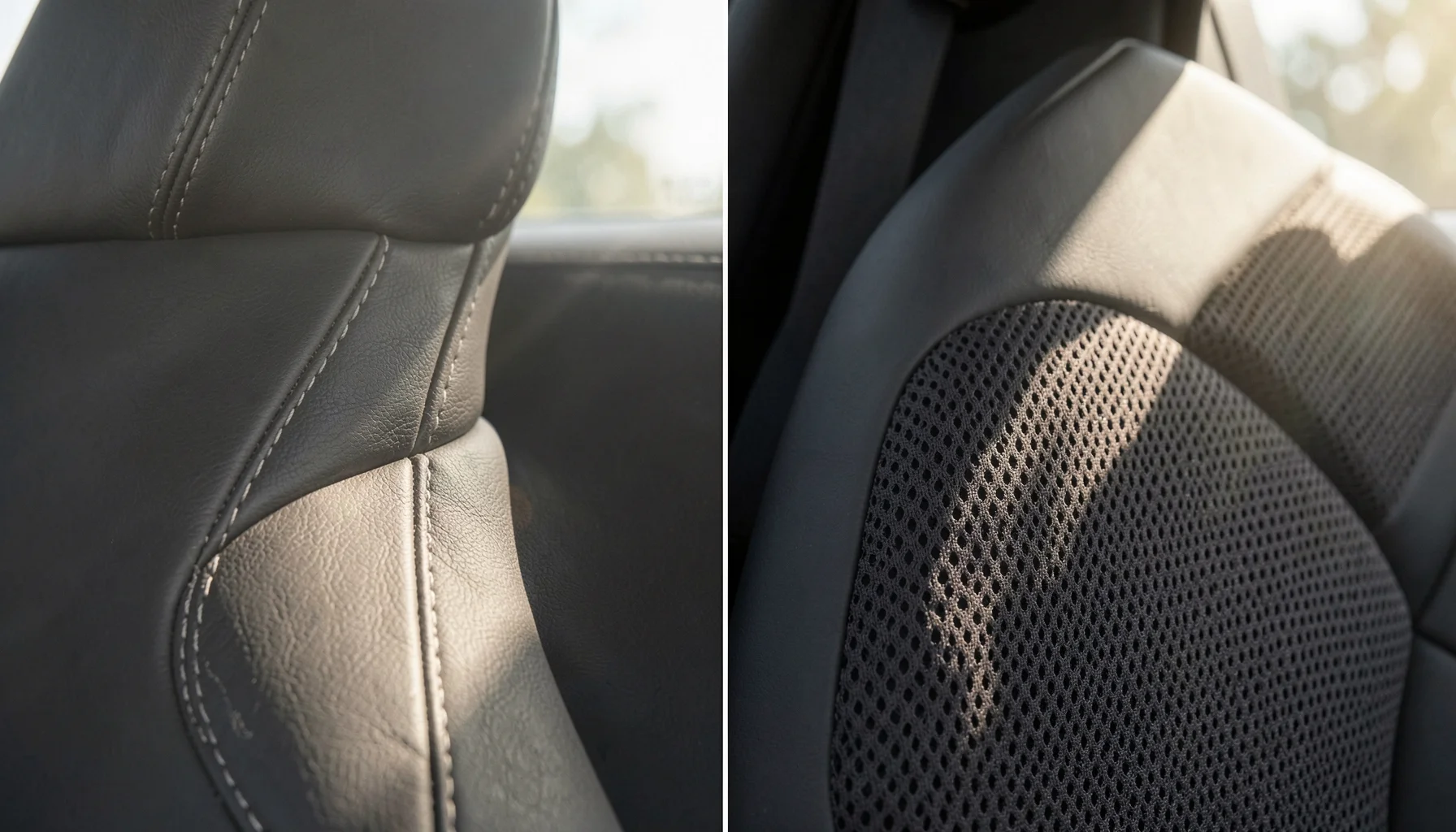 Leather vs Mesh Car Seat Covers: Climate and Comfort - Leather vs Mesh Car Seat Covers: Core Differences
| Criterion in English | leather vs mesh car seat covers | mesh car seat covers | Verdict in English |
|---|---|---|---|
| Typical pricing | Synthetic leather is generally mid-range; genuine leather is the most expensive | Market benchmarks: $20–$40 per pair for entry-level universal options, $50–$100 mid-range, and $150–$300+ for premium or vehicle-specific options | Mesh spans a broad price range; compare the specific product and fit |
| Core features | Smooth, upholstery-like appearance; sealed surfaces are easier to wipe | Porous woven polyester or nylon allows airflow | Choose for appearance and surface cleaning, or for breathability |
| Hot-weather comfort | Non-perforated leather can absorb heat and feel sticky | Open weave promotes airflow and can reduce sweat buildup | Mesh for hot or humid driving |
| Spill limitation | Sealed leather can contain surface spills, though care still matters | Liquids can pass through to factory upholstery unless a waterproof liner is present | Leather for surface spills; verify any mesh liner claims |
| Durability trade-off | Resists abrasion and tearing but can be punctured | Resists punctures but can snag or fray with heavy use | The likely wear matters more than a blanket material claim |
| Upkeep | Wipe with a pH-neutral cleaner; periodic conditioning may help prevent cracking | Vacuum and spot-clean; follow product directions and dry fully | Cleaning needs differ by material |
| Installation and fit | Fit and fastening depend on the individual cover | Universal designs may use straps, hooks, and anchors; vehicle-specific options vary | Check fit instructions and airbag compatibility before buying |
Mesh’s main functional advantage is its open weave, which allows air to circulate between the seat and occupant. That can make it a more comfortable everyday option for drivers who perspire easily or spend long hours behind the wheel in hot, humid conditions.
Leather, whether genuine or synthetic, offers a smoother, more refined look. A sealed surface is easier to wipe after many everyday spills, but it can warm up in direct sun and feel cold in freezing weather. Perforated or center-mesh designs may combine contrasting materials, but check the actual product construction rather than assuming a cover is ventilated.
Neither material automatically protects against every mess. Mesh can let liquid reach the factory seat, while leather’s spill resistance depends on its finish and construction. For a broader look at material and fit considerations, see YourCarButBetter’s complete guide to car seat covers.
Which Material Works Better in Everyday Use?
Mesh is generally more comfortable in hot conditions because air moves through its porous weave; leather is easier to wipe and delivers a more luxurious appearance. Installation effort depends more on the cover’s design and your vehicle’s seat than on the material alone.
For either type, use this practical installation sequence:
- Prepare the seat: Remove the headrest if the cover instructions call for it, and clear debris from the seat.
- Position the cover: Drape it over the backrest and align its seams with the seat’s contours.
- Secure the anchors: Feed the anchor discs or straps through the seat crevice, where applicable.
- Fasten underneath: Attach hooks or buckles as directed, distributing tension evenly. Avoid electrical wires under the seat.
- Check safety and fit: Reinstall the headrest and confirm that the cover does not obstruct seat controls or the side-impact airbag area.
Installation steps vary by product, so follow its instructions rather than assuming all covers attach the same way. Most importantly, verify that the cover is explicitly identified as compatible with your vehicle’s side-impact airbags and that its design does not block the deployment zone. An unsuitable or incorrectly installed cover can interfere with airbag deployment.
Care routines also differ. For leather, use a pH-neutral cleaner and microfiber cloth; conditioning every three to six months may help maintain suppleness. Mesh can be vacuumed with a brush attachment and spot-cleaned with mild detergent, then dried completely to help prevent mildew. Some mesh covers may be machine washable, but check the label and avoid assuming that every design is.
If airflow is your priority, YourCarButBetter’s overview of breathable mesh car seat covers for hot-weather driving offers more context on that use case.
What Should You Choose for Comfort and Value?
Choose mesh if hot-weather comfort and airflow matter most; choose leather if you value an upscale appearance and easier surface-level spill cleanup. Pricing depends on material, construction, and fit, so compare actual product details instead of relying on a generic “best value” label.
Mesh pricing in the market ranges from $20–$40 per pair for entry-level universal covers to $50–$100 for mid-range options with features such as enhanced foam padding or reinforced stitching. Premium or vehicle-specific options may run $150–$300 or more. These are broad benchmarks, not YourCarButBetter product prices or guarantees about what any cover includes.
Synthetic leather is generally mid-range, while genuine leather is typically the most expensive option. The supplied market information does not establish exact leather price ranges, so compare current listings directly. Look beyond the purchase price: consider whether the cover fits your seat, how often you will clean it, and whether a mesh cover needs an additional liner for liquid protection.
Leather advantages
- Upscale, smooth appearance
- Easier surface cleanup when the finish is sealed
- Good resistance to abrasion and tearing
Leather limitations
- Can absorb heat in sun and feel cold in winter
- Non-perforated surfaces offer less airflow
- Sharp objects can puncture it; conditioning may be needed
Mesh advantages
- Airflow can improve comfort during hot or humid drives
- Often available at lower entry-level prices
- High resistance to punctures
Mesh limitations
- Spills may pass through to the original seat
- Snagging or fraying can occur over time
- Its sporty or utility appearance may not suit a luxury-style interior
For families, pet owners, and rideshare drivers, weigh airflow against the kind of mess you are most likely to encounter. Mesh may suit claw-related wear, but it is not a liquid barrier. If spills are a regular concern, look for a product with a clearly specified waterproof liner rather than assuming mesh itself will block moisture.
Bottom line: Pick mesh for warm-climate comfort, frequent driving, or airflow over a refined look. Pick leather for cabin appearance and simpler surface-level cleanup, especially in a temperate climate. If you want both qualities, consider a center-mesh design with leatherette bolsters—but verify the materials, fit, cleaning instructions, and airbag compatibility for the exact cover.
FAQ
Are mesh car seat covers cooler than leather?
Generally, yes. Mesh’s open weave allows airflow, which can reduce heat and sweat buildup against the seat. Non-perforated leather is less breathable and may feel hot after sitting in direct sun. Actual comfort also depends on cabin temperature, seat construction, and the specific cover’s design.
Do mesh car seat covers protect against spills?
Not by themselves in most cases. Because mesh is porous, liquids can pass through to the original upholstery unless the cover includes a waterproof liner. Check the product’s stated construction and care instructions before buying, and clean spills promptly to reduce the chance of moisture lingering in the seat.